Event Transfers
Vaisakhi Festival 2026 UK: Dates, Celebrations & Where to Experience It
Vaisakhi is one of the
Vaisakhi is one of the most significant dates in the Sikh calendar. Across the United Kingdom, the celebrations do not fall on a single day in a single city. They span weeks, cities, and communities. This guide maps everything you need to plan, participate, and arrive prepared.
If you have ever tried to plan around Vaisakhi and found yourself uncertain about which event is happening when, which city is closest, or whether celebrations near you have already passed, you are not alone. The festival is observed on 13 April in the Nanakshahi calendar, but the UK’s major public celebrations are spread deliberately across the surrounding weeks to allow working families, students, and communities across the country to participate fully. Without a clear map of what is happening where, it is easy to miss the events that matter most.
This guide covers the official date, the history and meaning of the festival, and every major celebration taking place across the UK in 2026, with the detail needed to plan a day that is genuinely meaningful rather than last-minute.
Vaisakhi carries two distinct layers of significance, and both are worth understanding before attending any celebration.
The first is agricultural. Long before the Khalsa was founded, Vaisakhi marked the spring harvest in Punjab, a region whose identity is inseparable from the land. Farmers celebrated the gathering of the rabi wheat crop, offering thanks and gathering for communal festivals at a time when the plains of northern India were at their most abundant. That spirit of gratitude and collective celebration still runs through every langar served and every procession walked today.
The second layer is the one that defines Vaisakhi for Sikhs above all else. On 13 April 1699, the tenth Guru of the Sikhs, Guru Gobind Singh Ji, called a great gathering at Anandpur Sahib. Before thousands of assembled devotees, he made an extraordinary demand: he called for a Sikh willing to give his life for his faith. One man stepped forward. Then another. Then three more, each led into a tent while the crowd stood in silence. When Guru Gobind Singh Ji emerged, he presented all five men unharmed, dressed in saffron, transformed. These were the Panj Pyare, the Beloved Five, the first members of the Khalsa, the community of initiated Sikhs bound by principles of equality, courage, and service.
That moment is what every Nagar Kirtan procession commemorates. The five figures in saffron who lead every parade are a living reference to those five original volunteers.
Vaisakhi is not simply a celebration of something that happened. It is an annual renewal of the values on which the Khalsa was founded: equality without condition, service without expectation, courage without reservation.
The official date of Vaisakhi 2026 is Monday 13 April. This is fixed by the Nanakshahi solar calendar, which governs the Sikh religious year and keeps the festival consistent from year to year, unlike festivals tied to lunar calculations that shift significantly each cycle.
Because 13 April falls on a weekday, most of the UK’s major public events are scheduled for the Sundays and Saturdays immediately before and after. This is deliberate and practical: it allows the widest possible community participation without people missing work or school. The spiritual observance on the actual day, however, remains deeply important for practising Sikhs. Gurdwaras across the country hold special prayer services, Akhand Path (the continuous reading of the Guru Granth Sahib), and Amrit Sanchar ceremonies on and around 13 April regardless of when the public events fall.
Vaisakhi is not a UK public holiday. Schools, banks, and most businesses remain open on 13 April.
Whether attending a major city parade or a local gurdwara event, the core elements of Vaisakhi remain consistent. Understanding them before you arrive makes the experience far richer.
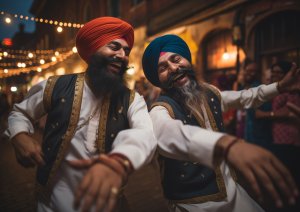
The centrepiece of Vaisakhi in the UK is the Nagar Kirtan, a moving street procession in which the Sikh community walks together through city streets, singing kirtan, the devotional hymns of the Guru Granth Sahib. The procession is led by the Panj Pyare, five initiated Sikhs dressed in saffron representing the Beloved Five of 1699. Behind them moves a beautifully decorated float carrying the Sri Guru Granth Sahib, the Sikh holy scripture. Gatka performers, practitioners of the traditional Sikh martial art, demonstrate their discipline alongside the procession.
The 2-mile Southall Nagar Kirtan, for example, typically takes five hours to complete, not because the distance demands it, but because the procession moves slowly and deliberately, with singing, prayer, and community gathering at every step.
Langar is the free communal meal served at every gurdwara and at major outdoor Vaisakhi events. It is vegetarian, prepared by volunteers, and served to anyone regardless of faith, background, or social status. Sitting cross-legged on the floor to receive langar is not a formality. It is one of Sikhism’s most powerful expressions of equality: no hierarchy, no distinction, no table at which one person is elevated above another.
At major Vaisakhi celebrations, langar extends far beyond the gurdwara. Food stalls lining parade routes distribute meals freely to tens of thousands of people. None of it is sold. All of it is seva, selfless service.
Gatka is the traditional Sikh martial art, a discipline that combines combat techniques with spiritual principles. At Vaisakhi events, Gatka demonstrations are a highlight of the outdoor programme, performed by practitioners of all ages in traditional attire. Watching a skilled Gatka performance is to see something that sits equally between athletics, devotion, and history.
Vaisakhi is considered the most auspicious day in the Sikh calendar for Amrit Sanchar, the Khalsa initiation ceremony, in which Sikhs formally commit to the five Ks and the principles of the Khalsa. The ceremony takes place inside gurdwaras and is a profoundly significant personal moment for those who choose it. Many Sikhs in the UK choose Vaisakhi as the day they take Amrit.
The UK’s Sikh community is concentrated in London, the West Midlands, Leicester, and Glasgow, and each region hosts its own programme of events. The celebrations listed below are confirmed for 2026.
One of Europe’s largest Nagar Kirtans, held annually in Southall, the heart of the Sikh community in West London. The procession departs from the Guru Nanak Road Gurdwara after 11am and travels through King Street, past Southall train station, along South Road and Uxbridge Road to Park Avenue Gurdwara. Road closures are in place throughout. Avoid driving into Southall: parking suspensions begin at 8am and congestion is significant.
The Mayor of London’s official Vaisakhi celebration, held at Trafalgar Square. Free entry. The programme includes live cultural performances, Gatka martial arts demonstrations, Sikh art and heritage exhibitions, community stalls, and langar served in the spirit of the Sikh tradition of sharing. Accessible via the Tube; nearest step-free access is Westminster station on the Jubilee, District, and Circle lines.
Leicester’s large and established Sikh community marks Vaisakhi with gurdwara-based celebrations, local Nagar Kirtans, Gatka demonstrations, and community outreach events. The Midlands Langar Seva Society and local organisations host public programmes in the city centre. Check local gurdwara listings for specific timings and routes.
Glasgow has a well-established Sikh community and hosts its own Nagar Kirtan annually, as do Manchester and Leeds. Celebrations are community-led and organised through local gurdwaras. Those in these cities should contact their nearest gurdwara directly for confirmed 2026 event details, as timings are typically confirmed in the weeks before Vaisakhi.
Gurdwaras are open to everyone during Vaisakhi, regardless of faith or background. Attending is one of the most direct ways to experience the festival as it is actually lived by the community rather than as a public spectacle. A few practical points make the visit straightforward.
The practical reality of attending a major Nagar Kirtan is this: road closures and parking suspensions are substantial, public transport is busy, and arriving without a plan costs time and causes frustration. For families travelling with young children or elderly relatives, or for anyone arriving from outside the city, the logistics of the day deserve as much thought as the event itself.
At the Southall Nagar Kirtan, the police advise strongly against driving into Southall on the day. Parking suspensions are in place from 8am across the procession route and surrounding streets. The Overground and Elizabeth line serve Southall directly. Central London’s Vaisakhi on the Square at Trafalgar Square is most smoothly reached via Westminster Underground station, which offers step-free access from platform to street level on the Jubilee, District, and Circle lines.
For those travelling from further afield to Birmingham’s Vaisakhi Mela at Handsworth Park, or making the journey to Vaisakhi in the Park at Victoria Park in Smethwick, a pre-booked door-to-door transfer removes the uncertainty of navigating unfamiliar streets on a busy event day. Services like Umbrella Transfers offer fixed pricing, flight monitoring for those arriving from elsewhere in the UK or abroad, and vehicles accommodating groups of up to eight, which makes the journey straightforward for families who would otherwise be coordinating multiple cars or navigating bus routes across an unfamiliar city.
For groups, families, or anyone arriving from outside a celebration city, Umbrella Transfers provides door-to-door service with fixed pricing, no surge charges on event days, and free waiting time if plans shift. Available across all major UK cities, with 24/7 real-person support and vehicles for up to eight passengers. Book via the app, website, or email.
The UK is home to one of the largest Sikh communities outside of Punjab. The majority are concentrated in the West Midlands, London, Leicester, and Glasgow, with well-established communities in Manchester, Leeds, Coventry, and Wolverhampton. The festivals described in this guide reflect that geography directly.
Vaisakhi in the Park at Victoria Park in Smethwick is the most family-complete event in the 2026 calendar. The dedicated Kids Zone, the Gatka demonstrations, the Bazaar, and the open-air Darbar provide a full day’s programme for every age. Trafalgar Square on 18 April is equally welcoming for families, with a central London setting, free entry, and an accessible programme that runs for six hours.
The Trafalgar Square event is the most accessible starting point for anyone attending Vaisakhi for the first time. The Mayor of London’s official programme is designed explicitly as a public, educational, and cultural celebration. Heritage exhibitions, community stalls, and cultural performances provide context alongside the celebration. The langar served at the event is open to all.
The Southall Nagar Kirtan on 29 March is the choice for anyone who wants to experience a Nagar Kirtan at its most immersive. The procession draws tens of thousands of participants and takes approximately five hours to complete its two-mile route. It is the kind of event that requires arriving early, planning transport carefully, and being prepared to walk alongside the community rather than simply watch from the side.
Vaisakhi is not one event. It is a season, and it belongs to every community that has made this country its home. From the streets of Southall in late March to Victoria Park in Smethwick in May, the celebrations of 2026 span six weeks, multiple cities, and a breadth of experience that ranges from intimate gurdwara prayer to processions that fill entire postcodes with sound, colour, and community.
The festival has survived centuries, crossed continents, and taken root in every city where the Sikh community has settled. In the UK, it has become something more than a religious observance. It is a demonstration of what a community looks like when its values are expressed openly, generously, and without condition.
Mark the dates. Plan the journey. And wherever you join the celebration this April and May, arrive prepared to participate rather than simply observe. That distinction is, perhaps, the spirit of Vaisakhi itself.
Vaisakhi is one of the

Every April, London does something